Introduction
Choosing the right flooring for a pool table is a critical decision that influences gameplay, durability, and overall aesthetics of a game room. This guide explains the essential factors that affect flooring performance, reviews the most suitable material categories, and recommends specific products that meet professional standards. Readers will learn how to evaluate surface hardness, vibration absorption, and maintenance requirements while staying within budget constraints. By the end of the article, the reader will be equipped to select, install, and maintain flooring that enhances both the visual appeal and functional longevity of a pool table.
Background and Context
Pool tables rely on a stable, level platform to ensure accurate ball roll and consistent cue response. A floor that is too soft can cause excessive flex, while a surface that is overly hard may transmit vibrations that distort shot precision. Historically, hardwood and slate foundations were common, but modern game rooms often incorporate modular carpet tiles or engineered laminates for cost‑effectiveness and design flexibility. Understanding the physics of ball movement and the role of floor compliance helps the reader appreciate why certain materials outperform others in a recreational setting.
In addition to performance, the flooring must withstand foot traffic, occasional spills, and the weight of the table itself, which typically ranges from 150 to 250 pounds. Environmental factors such as humidity and temperature fluctuations can affect both the table and the floor, making moisture‑resistant options desirable. Finally, aesthetic integration with surrounding décor contributes to the overall experience, making style a legitimate consideration alongside technical specifications.
Flooring Materials Suitable for Pool Tables
Several material families dominate the market for game‑room flooring. Each family offers distinct advantages and trade‑offs that align with different priorities such as budget, installation ease, and acoustic performance. The following sections outline the most common choices and illustrate how they meet the criteria established in the background discussion.
Carpet Tiles: Versatility and Performance
Carpet tiles provide a balance of cushioning, vibration dampening, and design flexibility. Their modular nature allows for easy replacement of damaged sections, which is particularly useful in high‑traffic environments. The adhesive backing of many modern tiles eliminates the need for additional glue, simplifying installation for DIY enthusiasts.
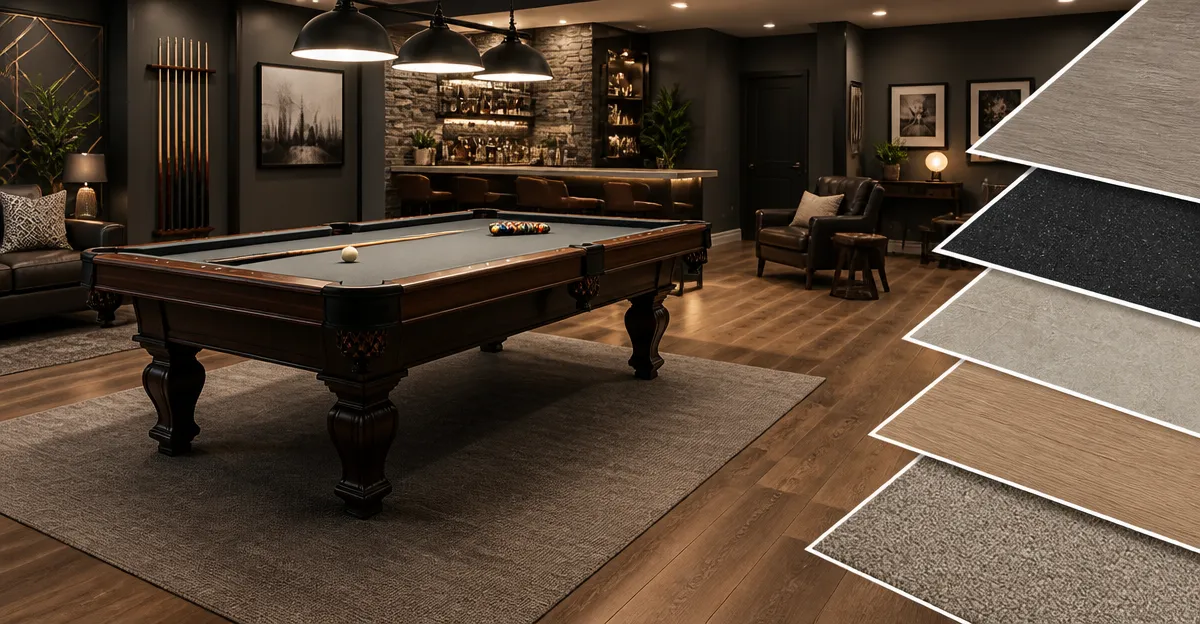
Mohawk Home Grey Carpet Tile exemplifies a high‑quality option. It features a 0.25‑inch pile height, 100% polyester fibers, and a peel‑and‑stick backing that adheres securely to concrete, wood, or tile. The product is rated 4.3 out of 5 stars based on 732 reviews, indicating strong customer satisfaction. Priced at $119.16 for a 60‑square‑foot box, it offers a cost‑effective solution for covering large areas while maintaining durability.
For darker interiors, Mohawk Home Black Carpet Tile delivers the same technical specifications as the grey variant but adds a sleek, modern appearance that can conceal stains and wear. It is priced at $134.56 and shares the same 4.3‑star rating, reinforcing its reliability across color options.
Brown and tan hues provide warm, natural tones that complement traditional game‑room décor. Mohawk Home Brown Carpet Tile and Mohawk Home Tan Carpet Tile each cost $138.87 and $149.48 respectively, reflecting the premium associated with deeper pigments. Both maintain the same 0.25‑inch pile, polyester construction, and adhesive backing, ensuring consistent performance regardless of color.
All Mohawk Home carpet tiles are engineered for indoor and outdoor use, offering stain resistance, fade‑proof color, and all‑weather resilience. The tiles can be trimmed to custom shapes, allowing the reader to create unique patterns that enhance the visual interest of a game room.
Reusable Modular Carpet Tiles
For readers seeking a reusable and easily maintainable option, VEVOR Gray Carpet Tiles present a compelling alternative. The set includes 24 tiles covering 96 square feet, each constructed with a five‑layer composition that combines a sturdy PP surface, a 0.24‑inch thickness, and an anti‑slip asphalt backing. The product is priced at $97.90 and holds a 4.1‑star rating from 337 reviews.
These tiles are designed for quick installation using 40 adhesive stickers, eliminating the need for separate glue. Their reusable nature allows the reader to replace individual tiles that become stained or damaged without discarding the entire rug. This feature aligns with sustainability goals and reduces long‑term replacement costs.
While the VEVOR tiles are slightly thinner than the Mohawk options, they still provide adequate cushioning for most recreational applications. The gray color offers a neutral backdrop that pairs well with a variety of furniture styles, making it suitable for both contemporary and classic game‑room designs.
Hard Surface Options
Hard flooring such as engineered hardwood, laminate, or polished concrete delivers a firm, level foundation that minimizes flex and maximizes cue precision. These surfaces excel in acoustic clarity, allowing the natural sound of ball impact to resonate without excessive muffling. However, they may transmit vibrations more readily than carpeted solutions, potentially affecting shot consistency.
Engineered hardwood combines the aesthetic richness of traditional wood with enhanced stability against humidity changes. Laminates mimic the appearance of hardwood while offering a more affordable price point and resistance to scratches. Polished concrete provides an industrial look and exceptional durability but may require a specialized underlayment to prevent cracking under the heavy load of a pool table.
When selecting a hard surface, the reader should verify that the subfloor is perfectly level and that any seams are sealed to prevent moisture ingress. Adding a thin rubber or cork underlayment can improve vibration dampening without sacrificing the firmness required for accurate play.
Comparison and Selection Guide
| Criteria | Mohawk Home Carpet Tiles (Grey, Black, Brown, Tan) | VEVOR Gray Carpet Tiles | Hard Surfaces (Hardwood, Laminate, Concrete) |
|---|---|---|---|
| Cost per 60‑sq‑ft | $119‑$150 | $97.90 for 96 sq‑ft | Varies widely; typically $3‑$6 per sq‑ft |
| Installation Difficulty | Easy DIY peel‑and‑stick | Sticker‑based, single‑person install | Professional installation recommended |
| Durability (Foot Traffic) | High, suitable for basements and garages | Moderate, designed for indoor use | Very high, especially concrete |
| Vibration Dampening | Excellent due to carpet pile | Good, thinner construction | Limited unless underlayment added |
| Aesthetic Flexibility | Custom patterns via trimming and rotation | Uniform gray appearance | Depends on finish and stain options |
| Customer Rating | 4.3/5 (732 reviews) | 4.1/5 (337 reviews) | Varies by product |
Based on the comparison, readers who prioritize ease of installation, vibration control, and modular replacement should favor the Mohawk Home carpet tiles. Those who need a reusable, budget‑friendly solution may opt for VEVOR Gray Carpet Tiles. For a premium, ultra‑stable platform, hard surfaces remain the optimal choice, provided that a suitable underlayment is employed.
Best Practices and Tips for Installing Flooring Under a Pool Table
- Verify Levelness: Use a long spirit level to confirm that the subfloor is flat within 1/8 inch over the entire table footprint. Any deviation can affect ball roll.
- Prepare the Surface: Clean the subfloor thoroughly, removing dust, grease, or moisture. For concrete, a moisture‑resistant primer can improve adhesion of carpet tiles.
- Lay a Protective Underlayment: When using hard surfaces, install a 1‑mm rubber sheet to reduce vibration transmission while preserving firmness.
- Follow Tile Orientation Guidelines: Rotate each carpet tile 90 degrees relative to its neighbor to create a staggered pattern that enhances visual stability and reduces seam visibility.
- Trim Tiles Precisely: Use a sharp utility knife and a straight edge to cut tiles around the table legs and any irregular corners. Accurate cuts prevent gaps that could catch debris.
- Secure Edges: Press the adhesive backing firmly for at least 30 seconds per tile. For high‑traffic areas, consider applying a thin line of carpet tape along the perimeter for added security.
- Maintain Regular Cleaning: Vacuum the carpet tiles weekly and spot‑clean spills promptly. For outdoor installations, rinse with a garden hose and allow to air‑dry.
Adhering to these practices ensures that the flooring not only supports optimal gameplay but also retains its appearance and functionality over years of use.
Frequently Asked Questions
- Can carpet tiles be used on concrete floors? Yes, carpet tiles with a peel‑and‑stick backing, such as the Mohawk Home series, are designed to adhere directly to concrete after proper cleaning and drying.
- How much weight can a typical carpet tile support? The polyester carpet tiles listed can comfortably support the weight of a standard pool table (150‑250 lb) when installed on a level subfloor.
- Do carpet tiles affect the speed of the balls? Carpet tiles introduce a modest amount of friction, which can slightly reduce ball speed. Most players find the trade‑off acceptable for the added vibration dampening.
- Is it necessary to use a rug pad beneath carpet tiles? A rug pad is not required for peel‑and‑stick tiles, but a thin rubber underlayment can improve stability on hard surfaces.
- Can the tiles be removed and repositioned? Yes, the adhesive backing allows for removal and repositioning, though repeated moves may reduce stickiness over time.
- Are there fire‑safety considerations? All listed carpet tiles meet standard fire‑retardant requirements for residential flooring, but the reader should verify local building codes for commercial installations.
- How do I clean stains from the carpet tiles? Spot‑clean with mild detergent and water; for outdoor tiles, a garden hose can rinse away dirt without damaging the backing.
Conclusion
The flooring beneath a pool table plays a decisive role in gameplay precision, durability, and visual harmony of the game room. By understanding the interplay between surface firmness, vibration absorption, and maintenance needs, the reader can make an informed decision that aligns with personal preferences and budget constraints. Whether the reader selects the premium Mohawk Home carpet tiles for their modular convenience, the reusable VEVOR Gray Carpet Tiles for cost efficiency, or a hard‑surface foundation for ultimate stability, the guide provides the knowledge required for successful installation and long‑term satisfaction.
Implementing the best‑practice tips outlined above will ensure that the chosen floor performs optimally for years to come, creating a welcoming environment for both casual play and competitive matches.
Products Featured in This Guide
Mohawk Home Grey Carpet Tile
Price: $119.16 | Rating: 4.3/5 (732 reviews)
Featured because it offers a durable, peel‑and‑stick polyester carpet tile that balances cost, ease of installation, and vibration dampening for pool tables.
Mohawk Home Black Carpet Tile
Price: $134.56 | Rating: 4.3/5 (732 reviews)
Featured for its sleek dark tone, which hides stains while providing the same performance characteristics as the grey variant.
Mohawk Home Brown Carpet Tile
Price: $138.87 | Rating: 4.3/5 (732 reviews)
Featured because the warm brown hue adds a classic, inviting atmosphere while maintaining the same durability and installation ease.
Mohawk Home Tan Carpet Tile
Price: $149.48 | Rating: 4.3/5 (732 reviews)
Featured for its neutral beige tone that blends seamlessly with a variety of interior styles, offering the same robust performance.
VEVOR Gray Carpet Tiles
Price: $97.90 | Rating: 4.1/5 (337 reviews)
Featured for its reusable design, easy sticker‑based installation, and cost‑effective coverage, making it ideal for temporary or budget‑conscious game rooms.